AI Brief Analyzer
An AI-powered platform that transforms vague project briefs into structured technical analyses, including requirements, MVP scope, tech stack recommendations, risk assessments, and development cost estimations.
Project Overview
Understanding the Project
The Goal
Design and build an AI-powered system capable of transforming unstructured project ideas or client briefs into structured technical analyses that development teams can use to estimate scope, plan MVPs, and evaluate feasibility.
The Challenge
Ensuring consistent, structured outputs from multiple AI providers while maintaining transparent cost tracking, reliable schema validation, and a scalable architecture capable of handling analysis history, analytics, and multi-model experimentation.
My Role
Full-Stack Architect and AI Developer responsible for system architecture, AI integration strategy, prompt engineering, schema design, database modeling, frontend implementation, and production deployment.
Role
Full-Stack Architect
Timeline
2026
Platform
Web
Team
Solo
Screenshots
Visual Showcase
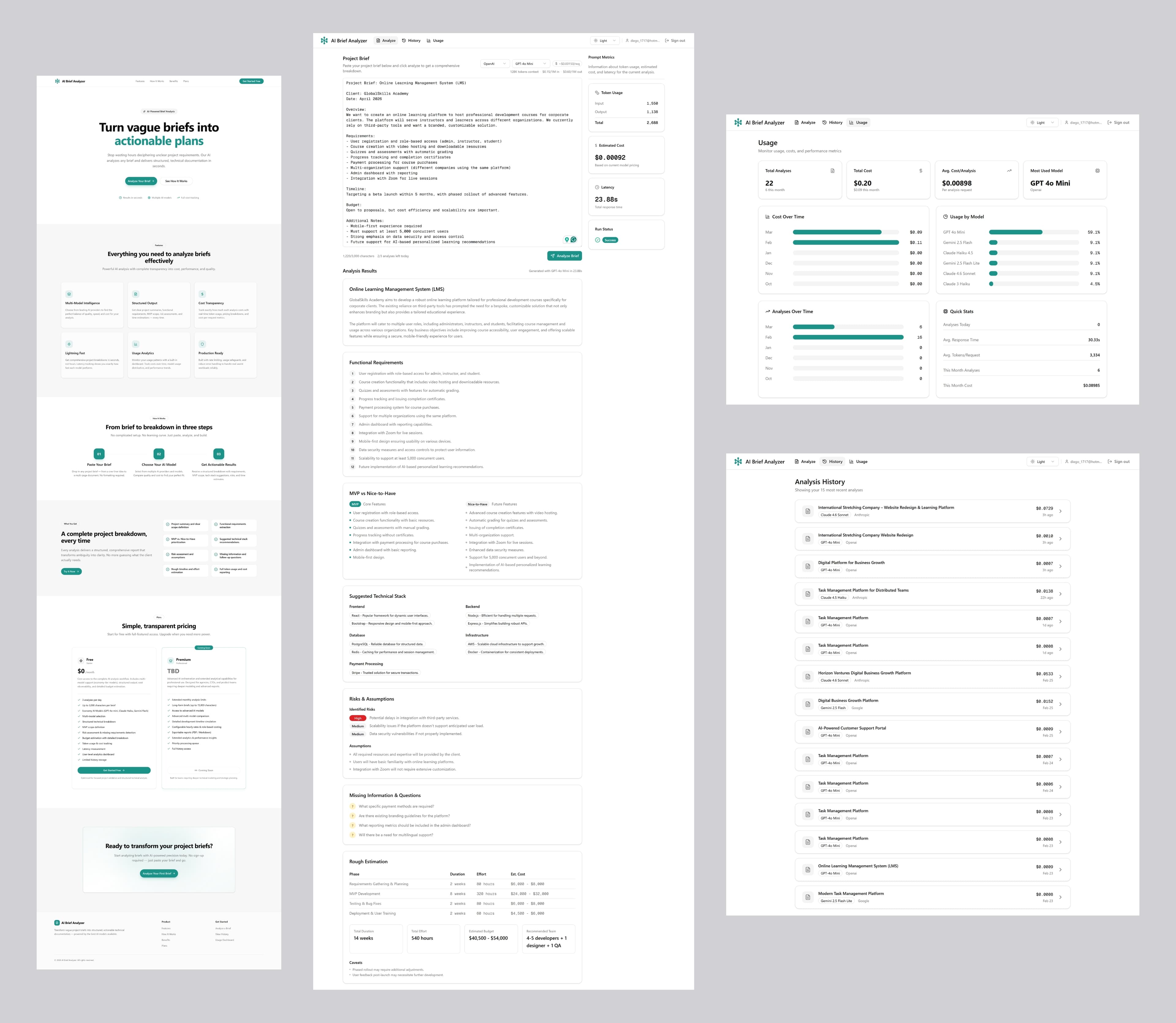
AI Brief Analyzer sections
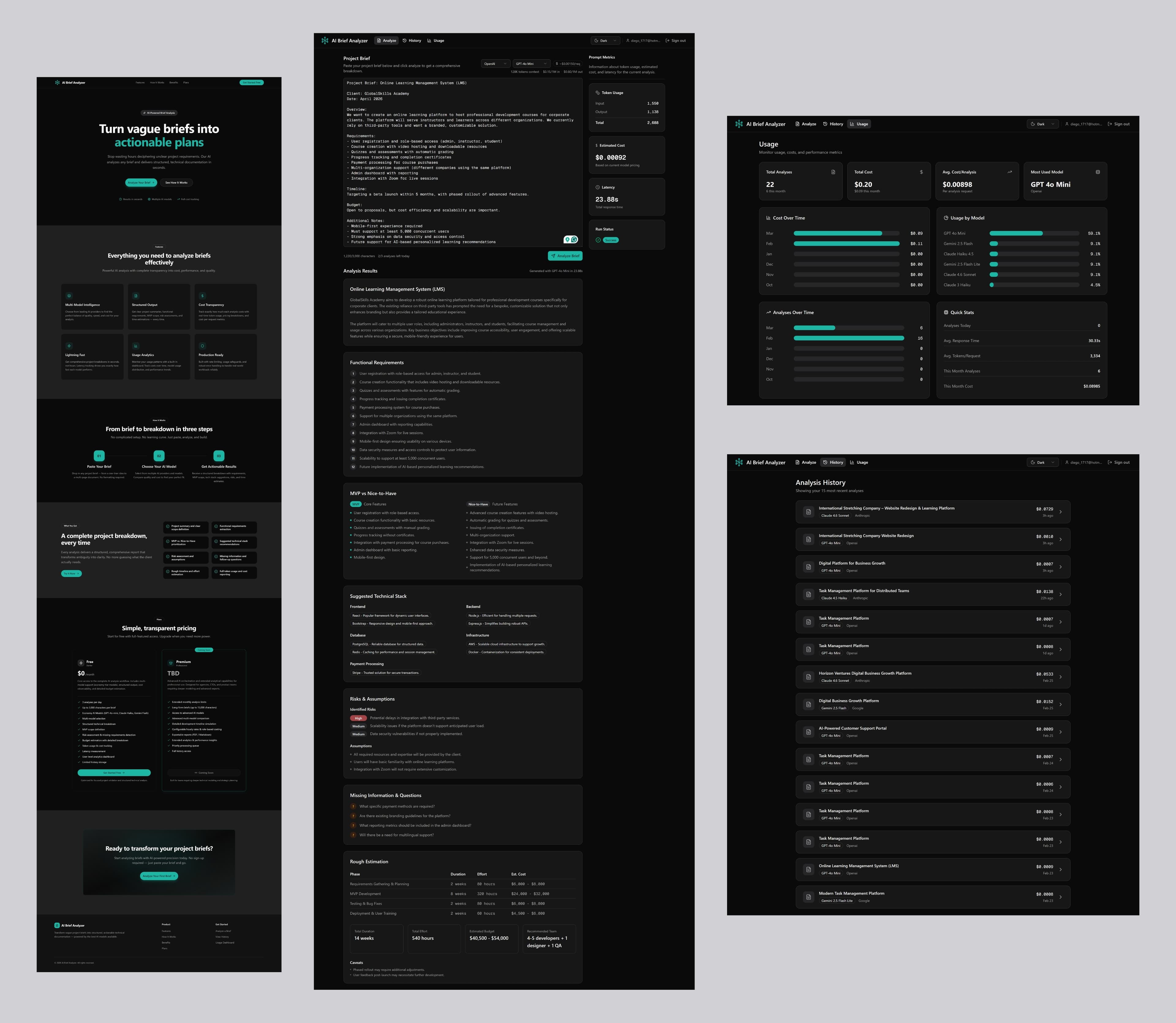
AI Brief Analyzer sections (Dark mode)
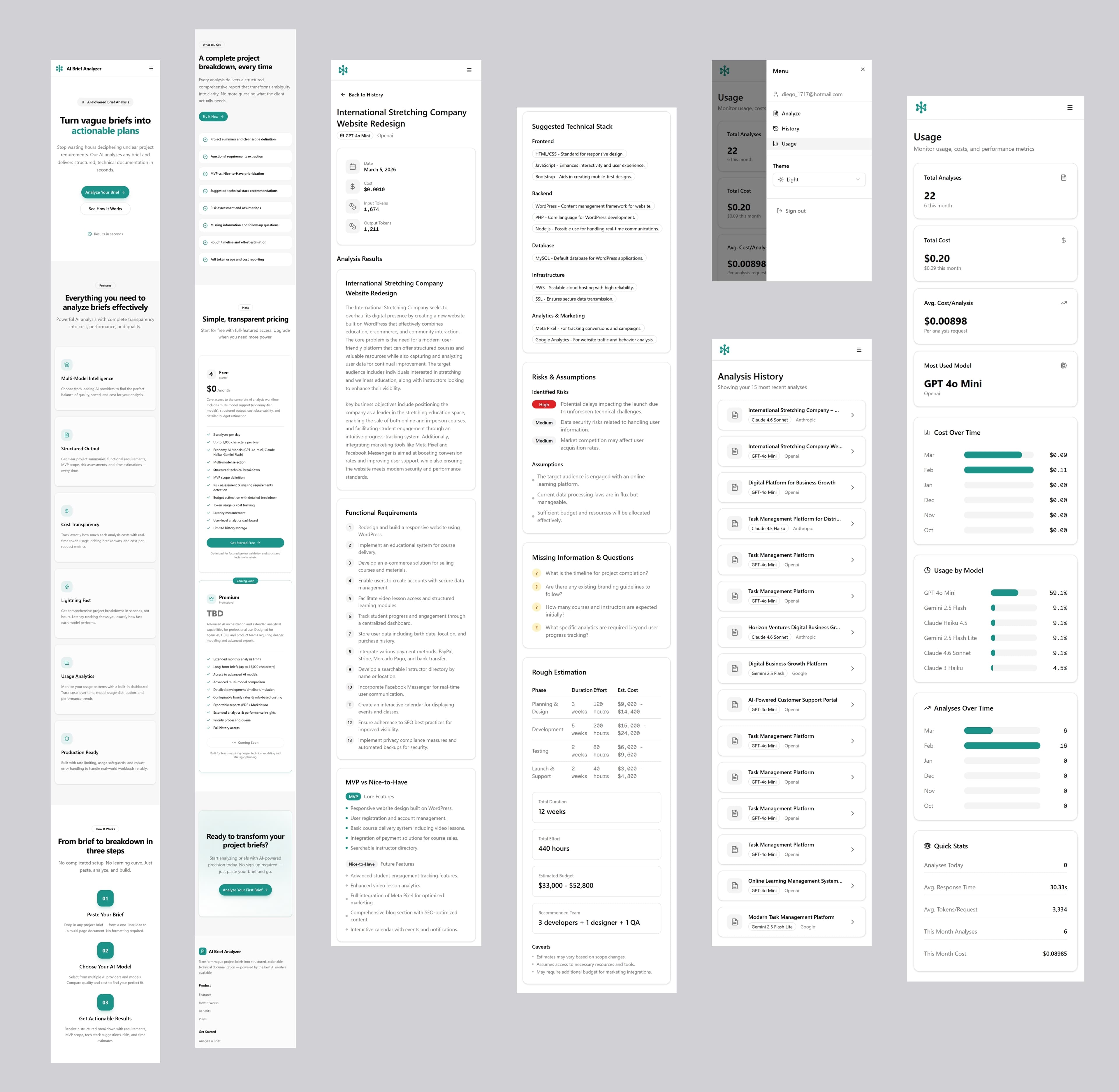
AI Brief Analyzer sections (Mobile version)
What I Built
- Architected and implemented a full-stack AI SaaS platform using Next.js App Router and TypeScript.
- Designed the prompt engineering strategy and system prompts that generate structured technical project analyses.
- Implemented schema-validated AI responses using Zod to ensure deterministic output structures.
- Built a multi-provider AI abstraction layer supporting OpenAI, Anthropic, and Google Gemini models.
- Developed cost and token tracking infrastructure displaying real-time model usage metrics per analysis.
- Designed and implemented an analytics dashboard to visualize usage trends, cost evolution, and model performance.
- Built persistent analysis history with PostgreSQL and Prisma ORM for full retrieval and auditing of past analyses.
- Implemented passwordless authentication using Supabase Magic Links and custom transactional email templates via Resend.
- Designed a responsive UI with TailwindCSS and Radix-based components optimized for both mobile and desktop.
- Implemented SEO optimization including dynamic metadata, OpenGraph cards, sitemap generation, and robots configuration.
Tech Stack
Frontend
AI & LLM Integration
Backend
Database
Authentication
Infrastructure
Integrations
Architecture Design Decisions
These decisions were intentional to ensure the site feels professional, calm, and easy to navigate:
- Implemented structured AI output validation using Zod schemas to guarantee consistent JSON responses across multiple LLM providers.
- Designed a centralized model registry that maps model identifiers to pricing, context limits, and capabilities, enabling real-time cost estimation and transparent usage reporting.
- Adopted Next.js Server Actions instead of traditional API routes to simplify server-side logic, reduce boilerplate, and colocate mutations with UI logic.
- Implemented application-layer rate limiting and analysis quotas to control AI costs while maintaining a frictionless free-tier experience.
- Designed an extensible architecture supporting multiple AI providers, allowing users to compare quality, cost, and latency between models.
Results & Learnings
The platform enables developers, founders, and product teams to quickly transform vague project ideas into actionable technical plans. It provides structured requirement breakdowns, MVP prioritization, cost estimations, and risk analysis while offering transparency into AI model performance, token usage, and operational cost.