AWS Cost Optimization & Cloud Audit
Led a strategic AWS cost and architecture optimization for a client running multiple production workloads. Eliminated over-provisioned infrastructure, modernized legacy databases, optimized observability, and migrated workloads to cost-efficient managed platforms, reducing the monthly bill from ~$1,100 to ~$250 (–77%).
Project Overview
Understanding the Project
The Goal
Reduce unnecessary AWS spend while improving architectural alignment, maintainability, and service lifecycle compliance across a multi-application environment.
The Challenge
The AWS account had grown organically over time, resulting in EC2 + Load Balancer usage for workloads better suited for managed platforms, legacy MySQL RDS versions incurring Extended Support costs, excessive CloudWatch logging/storage, unused Route 53 hosted zones/domains, and WordPress workloads running on costly compute despite an existing lower-cost hosting plan.
My Role
Full-Stack Architect / Cloud Consultant responsible for auditing AWS usage, proposing an optimization plan, executing migrations (Amplify, RDS upgrades, WordPress hosting), decommissioning infrastructure, and validating cost reductions and operational stability.
Role
Full-Stack Developer
Timeline
2025
Platform
Web
Team
Solo
Screenshots
Visual Showcase
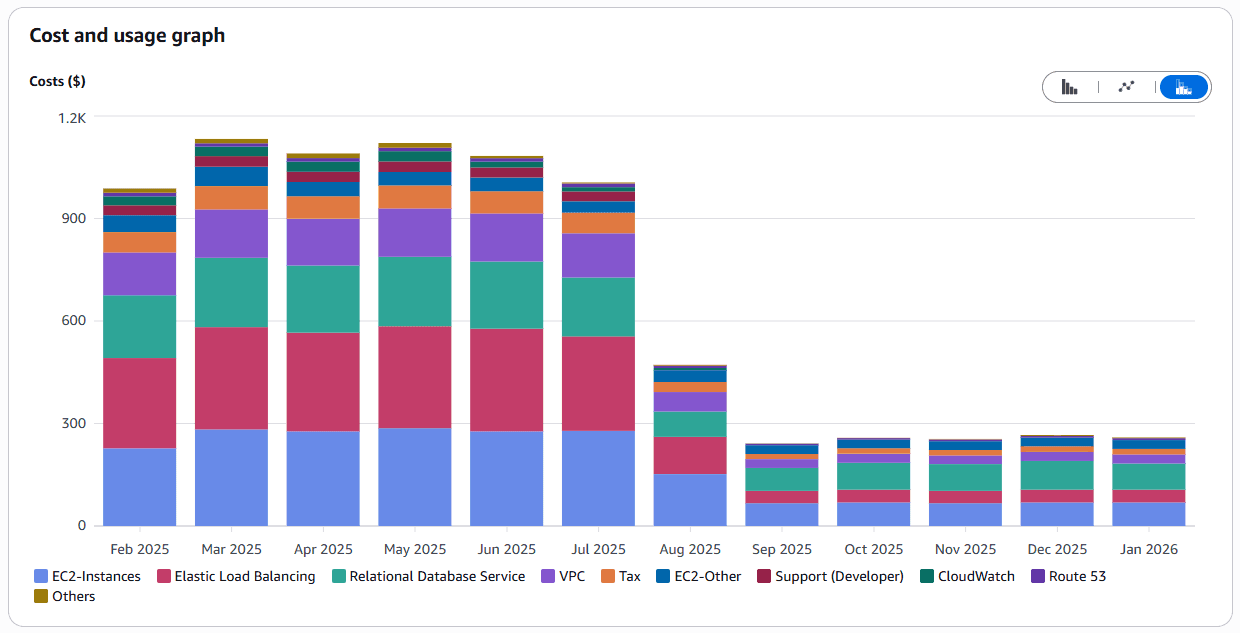
AWS Monthly Cost Trend — Optimization Implemented on August 2025
What I Built
- Performed a full AWS cost and service utilization audit to identify high-impact cost drivers.
- Migrated multiple React/Next.js applications from EC2 + Load Balancers to AWS Amplify and decommissioned the legacy infrastructure.
- Planned and executed MySQL RDS migrations to modern supported versions to eliminate Extended Support fees.
- Optimized CloudWatch logging by removing unnecessary verbose logs and deleting large volumes of aged log data.
- Downgraded AWS Support plan from Developer to Basic after confirming it had not been used for years.
- Migrated multiple WordPress sites from an EC2 instance to a lower-cost multi-site Hostinger plan and validated functionality.
- Cleaned up Route 53 domains/records no longer used after migrations.
Tech Stack
Cloud & Infrastructure
Database
Observability
Web Platforms
Practices
Architecture Design Decisions
These decisions were intentional to ensure the site feels professional, calm, and easy to navigate:
- Migrated React/Next.js workloads from EC2/LB to AWS Amplify to better match workload characteristics and reduce ops overhead.
- Upgraded MySQL RDS instances to supported versions to avoid Extended Support pricing and reduce long-term risk.
- Reduced CloudWatch costs by removing noisy logs and deleting very old log data while keeping operationally useful signals.
- Migrated WordPress sites off EC2 to an existing multi-site Hostinger plan to right-size compute for CMS workloads.
- Removed unused Route 53 domains/hosted zones and downgraded AWS Support plan to Basic due to long-term non-usage.
Results & Learnings
Reduced AWS monthly costs from approximately $1,100 to $250 (–77%), delivering an estimated $10K+ USD annual savings. Simplified frontend hosting by migrating React/Next.js apps from EC2/LB to Amplify, eliminated legacy RDS Extended Support charges via MySQL version upgrades, lowered CloudWatch storage by removing noisy/old logs, removed unused Route 53 domains, downgraded unused AWS Developer Support to Basic, and migrated WordPress sites from EC2 to a significantly cheaper multi-site Hostinger plan.